Monday, March 23, 2015

Traditional, western, or another path?


Which path should I take to treat an illness, “taking prescription medication, following traditional practices such as shamanism, listening to a homeopath, visiting an acupuncturist or bone setter (chiropractor), or using technique based on humoral medicine?” Often times in our society, one’s culture defines the “correct” path to treat an illness. There seems to be little incorporation of the different practices in order to achieve desired results. For example, a typical “western” doctor prescribing medicine usually would not also advise a patient to go to a sukkiah to heal his or her spirit; there is only one “right” path.

If someone wishes to take different approaches to healing a sickness, he or she has to actively seek out both approaches and confirm whatever treatment prescribed does not interfere or cause side effects with the other treatment. I know for me, this extra work greatly reduces my desire to use two different methods. Upon this realization, I began to question why this was the case and whether or not it was possible for two medicinal techniques to coexist.

I discovered my answer when we took our visit to the EBAIS in Coto Brus. The district of Coto Brus has a high population of Ngobe tribe who immigrate from Panama and non-indigenous peoples as well. In order to address both populations, this EBAIS has a shaman and a “western” medical doctor. As well, the buildings are set up in cone shapes and look almost identical to the houses the Ngobe tribes reside. Not only does it have a shaman and western doctor, but it also has a kitchen where concepts such as preventative care can be practiced. Finally, resources for midwives to help give births are provided. It is the only one of its kind. All of these facets of the EBAIS work together to encourage the public to be able to choose which cure or health care practice he or she prefers to use. Due to this systematic set up, there have been declines in the number of hospitalizations and a reduction in infant and mortality rate in the Ngobe community. As well, it has allowed a more amiable relationship between leaders of different cultural beliefs understanding perspectives from the others’ culture.

Making multiple medicinal paths easily available to patients gives patients the power to choose which or both practices he or she prefers. It also makes it easier for a patient to learn more about a different practice if he or she has been curious to test it out.

This EBAIS helped answer my question; it is possible for two methods of treating medicine to coexist. Hopefully in the future the United States can incorporate some type of healthcare system in which the patients do not have to choose only one “right” medicinal path.

Morgan Drew

The Free Time Dilemma


Having now been in Costa Rica just over two months, I have come to the realization that I still struggle with a common dilemma: what do I do with my free time? At first, the program was densely packed with activities, so the need to fill time rarely arose. Endearingly called the “day-by-day”, our group is provided with a weekly schedule that allocates when activities, lectures, or research projects will occur. However, once we all adjusted to the schedule and we started designing our own research projects, I realized that there were frequent blocks of time where no set activity was planned. By no means am I saying that balancing free time is a new concept for me, nor for any college student I would imagine, yet being in Costa Rica poses a different time management priority.

Here, we are not only research students, we are also foreigners and tourists. There is urgency in our actions to see and experience as much of the environment and culture as possible while still managing the requirements of the course. Everyday that I have been at this biological station in Las Cruces, I find myself making a decision to either go for a walk through the botanical gardens or study lecture material. It is often possible to do both, but then, which takes priority?

The formal education we receive through research and lectures is important, but so too is the informal education that we discover for ourselves when we explore our environment. For example when we go on group nature walks, there is both informal and formal education at the same time, but with other activities, there is a more obvious distinction in what type of education the activity provides. But then I wonder, is one more important than the other? When I leave here, what will I remember more, the material I learned in class or the times I spent outside in the forest? Realistically, I know it will be a mix of both, so I think that I need to maintain a balance between the two. I consider myself extremely fortunate that deciding how best to use my time is one of my tougher struggles here.

Liz Stratton

The Choice


          The sun is shining and the topical birds are chirping at Las Cruces Biological Station but the other students and I aren't paying any mind. We're eagerly awaiting the beginning of the presentation; the one that will tell us what independent project topics we can choose from. The decision each of us makes today will determine how we will spend much of the next month and a half in Costa Rica. As the lecture begins we sit quietly and listen to each topic as it's announced. There were eight available topics: weaning practices of breastfeeding mothers, patient overuse of the healthcare system, adherence to medication, plant-made insecticides, and more. Once all topics were explained we were told to pick which one we'd like to research. The other students jumped up to form groups and talk about their first choices. The room filled with chatter and commotion, but I was still sitting quietly. I was busy thinking. This was as important me me as it was for everyone else but I couldn't choose so quickly. I knew that I was curious about all of the listed topics and that in any group I would be able to drive into whatever research with enthusiasm. I didn't know what to choose, so I sat.

          After a minute we decided to discuss our options in a more organized way, so all 13 of us marched upstairs to our common room to talk. As we went around the circle naming our top choices I thought about one project in particular: "Knowledge, attitudes, and practices regarding prostate cancer screening." One of our professors had explained the importance of this topic, how for some men it was taboo and how the regional health director had specifically suggested it.

          I'd thought before about the lack of conversation around prostate cancer in the United States, especially compared to breast cancer, and it seemed interesting to learn more about it in Costa Rica. I began to have an inner battle. On one hand a part of me wanted to do this research project. As a young woman, coming to OTS from an all women's college I'd spent more time researching women's health topics and general health topics than men's health. Picking this topic would be a perfect way to begin learning more about issues specific to male populations. It was also especially interesting due to its taboo aspects and all of the misconception about masculinity that surrounded it. Still, an opposing part of me was nervous and cautious about choosing without fully thinking it through. Would I feel comfortable surveying complete strangers about this sensitive topic? Would I be making them feel uncomfortable? I talked with the two friends I'd be working with. They were both patient with my uncertainty. We discussed the possible benefits of the study with our professors. They assured us that it was a very interesting and useful study and even said that men may be more comfortable talking about this topic with us, three female student researchers, rather than other men. We went confidently into our days of initial online research of similar studies, and this week we handed in our formal research proposals. We are now waiting, enthusiastic and eager to go into the local communities and learn more

Erica Rayack

A Hidden Paradise


As we began to approach the next house for our interviews, I was reminded just how long this day would feel. In a small farming neighborhood in the rolling hills of San Vito, we set out for the day to conduct door-to-door surveys for our third faculty led project. Our surveys were about wild edible plants, and how many the people we interviewed could list for us. This was all to measure the amount of traditional ecological knowledge in this community. As excited as I was to conduct the surveys, it was a hot and dry day with an agenda of about 100 interviews total ahead of us. I had no idea that during this calculated afternoon we would have an unexpected experience that would change my perception of that day.

At this house in particular, we began to interview a woman, in her mid 50s, who very eagerly began to list as many wild edible plants as she knew. If we didn’t recognize the name, she took us to her garden and happily pointed it out. About 15 minutes into our conversation, she informed us that her family owned a farm that was connected to the back of the house. As her memory of the plans began to slow, she remembered that her husband would be able to recall more than her. “He’s out working on the farm”, she remarked “I’ll bring you to him!” Before we knew it, we were following her through rolling pastures and coffee fields to where her husband was working. A small wind sparked in the trees bringing to life this hidden paradise that I’m sure few eyes from the outside world have seen. As soon as we reached the top of the hill, her husband greeted us, setting aside the small coffee saplings he was planting. His wife explained why we were there and he immediately left his work, picked up a machete and told us to follow him. He led us through more of their property, pointing out plants as we went until we reached a small section of dense forest. In we went to find the wild plants we were in search of. We wandered about for almost 45 minutes with the couple sharing their livelihood with us and letting us try wild fruits like guava and guanabana.

As we left their house after our excursion, I was reminded of the beautiful hospitality Ticos share with complete strangers. This kind man and woman were so eager to share their little patch of heaven with a few researchers from America hoping to learn a little more about their culture. I will never forget this experience nor the immense kindness they showed us that afternoon.

Stephanie Hynes

Drugs or Culture?


          After an entire day of sitting in one room listening to lectures, the last thing you want to hear is that there is a lecture scheduled for after dinner as well. And yet that was exactly what our schedule looked like on our second day at the Las Cruces Biological Station. That evening, as we filed back into the classroom after dinner, the thought running through everyone's heads was simple: let's hope this is quick so we can finally relax. Moments after entering, however, that exhaustion slipped away and was replaced by curiosity mixed with excitement and a little bit of trepidation. The first slide was titled “Psychoactive plant use” and filled with colors in a manner which can only be described as trippy. The lecture proceeded to define words I've only ever heard thrown around colloquially, such as psychoactive, hallucinogenic, and psychedelic, and to discuss a variety of plants, their properties, and their current and historical uses. We learned how Shamans in the Amazon believe that Ayahuasca allows users to see the plant spirits coming alive in the forest. We learned how Iboga in Africa causes a frightening hallucination that is believed to connect users to their ancestors. And we learned how the Spanish conquistadors outlawed the peyote cactus to break the connection between the indigenous peoples and their gods.

         Drugs, in our time and especially in our place in life, are something which we are going to have to face. As an American college student, it is inevitable that I will encounter people who use and abuse drugs. But I've never considered them in the context of spiritual gateways or as ways to connect with a deity. The connotations around these substances in our society are clear. Adolescents may choose to experiment with illicit substances, but under no circumstances are they beneficial or important aspects of a cultural worldview.

         This stigma against hallucinogenic plants and drugs in general causes a dangerous lack of research into these important topics. I can feel this stigma just writing this blog post and knowing that there are people who are going to judge me for choosing to use my free writing to talk about drugs. But in our day in age I think we need to work past this stigma. Drugs are becoming increasingly dangerous because current regulation systems aren't stopping their use and are only serving to push them underground where the practices surrounding them are dangerous. At the very least we need research into the effects of these substances so that we can speak educatedly about them instead of just speaking from our fears and culturally engrained beliefs. Hallucinogens have been around forever. It's unrealistic to believe they are going to disappear now, so we might as well accept it and work with the system instead of against it.

Krcmar, Rachel

Seeing Ethnobiology in New Colors


Having a father in the military meant that I spent my childhood in a different country and a variety of states. As a result, I have had an interest in learning about cultures and ways of life different from mine since I was young. So far, this program has provided me with countless opportunities to do that, including: meeting other students and researchers at the stations, learning about Costa Rican life through living two weeks at my homestay in San Jose, and also through interacting and visiting indigenous communities. While in Las Cruces, we once again had the opportunity to visit and interact with an indigenous community, this time the Brunka people.

Our guest professor, Hector, first taught us about the Brunka of Costa Rica and how they have repurposed their ethnobiological knowledge. Because of tourism and conservationist policies of Costa Rica government, they have been increasingly using their useful organisms for economic purposes. An example would be the masks, or diablos that they make as well as sell, and the bags they weave. I enjoyed learning about how this shift and repurposing impacted women and the community and led to the revival of certain traditions like women’s groups, and found it extremely interesting.

Before the visit, we were told to bring some type of white, cotton material because we would have the opportunity to dye it. I have tie-died shirts before, but the process the Brunka women showed us was completely different than any I had seen before! When I had tie-died shirts as a kid it involved store bought dye or a tie-dying kit and a lot of rubberbands. In contrast, the indigenous women showed us how their process of dying was all-natural. They used different plants and leafs to make different colors. In their demonstration they died yarn, and showed how they may rub the plant against the yarn with water and the color begins to seep into it. The most remarkable part came next; they would lie the yarn out to dry in the sun and the colors would either change or become darker.

Then came the fun part. We had a chance to get involved and try it out for ourselves. They had set up a small fire with pots on top filled with yellow and blue dye. They used sticks to dip our pieces of clothing in the dye. It was very exciting to be a part of the cultural activity of the Brunka people. It is also neat that I now have a cool tie-died shirt to take back to the states to remind me of the Brunka women and the experience!

Symone Stephens

Expect the Unexpected


One of the most interesting things about Costa Rica thus far has been the hospitality. After just a short conversation with someone, they will tell you almost anything. I discovered this fact our first week in Las Cruces when we were conducting our interviews in the local community for our last Faculty Led Project. We were going door-to-door asking people about their knowledge of wild edible plants. We started pretty early in the morning, splitting in to groups of two or three, and we were expected to get a lot of interviews done before lunchtime. Interviewing people in Spanish always makes me a little nervous, so the thought of interviewing all morning was a little scary.

However, on my group’s third interview, our morning took an unexpected turn. The woman we were interviewing gave us a tour of her garden, naming different edible plants as she went along. Once she had exhausted all of her knowledge of edible plants, she then offered to take us to where her husband was working because he would know more plants than she would. Her husband was working on the other side of their three-hectare (7.5 acres) farm, which meant we had to trek down about half a mile in order to meet her husband. But this is when it got very interesting. He then insisted upon not just telling us the edible plants he knew, but showing them to us. So he began giving us a tour of basically their entire farm.

The walk was so interesting, although I was definitely not prepared for it. At one point, we had to walk straight through the woods, with the husband using his machete to cut a path for us because there was not an actual path. My converse shoes did not quite cut it for the walk through the forest, but it was totally worth it. He pointed out a lot of different plants that they had on their farm. We eventually came across a guava tree, where we could see this huge, almost ripe guava fruit. It was kind of high up in the tree, but he scaled the tree trunk and cut it down for us. He also climbed another tree in order to get us a guayaba fruit. It was a little bit funny to watch this grown man climb a tree, but mostly it was just awesome. He also picked about 10 lemons for us, although I’m not entirely sure what we are going to do with that many lemons…

All in all, it was a fantastic break from our interviews. We took an hour walking around the farm, where we had only planned on taking five minutes. I guess you have to expect the unexpected when you talk to complete strangers in a foreign country!

, Emily Leytham

Sunday, March 1, 2015

Pesticides en los PlƔtanos


On the afternoon of January 30, 2015 our group of thirteen college women (a.k.a. Las Gringas) had the privilege of visiting a large scale banana plantation. Jaime, a guest lecturer taught us about the banana's growth cycle, environmental problems concerning bananas, and health problems in banana plantation workers. I found it ironic how little any of us knew about banana farming despite bananas being the most widely eaten fruit in the world. I have eaten bananas my entire life yet I knew absolutely nothing about them prior to this field trip other than the simple facts that they were delicious, yellow, and knew no seasons (they are always in supermarkets). Jaime taught us that bananas are the largest herb in the world. Much deforestation has happened in order to make room for banana plantations. Jaime said that the 'Coryoyo' bananas most commonly grown in Central American originated from the Philipines and that there are millions of strains of bananas since they are so easy to cross with both animal pollinaters and the wind. What interested me most on this field trip was learning about the health risks of the plantation workers and the enviromental implications of using extravagant amounts of pesticides on the crops.

The worker population consists of roughly half Nicaraguans. Costa Rica is the 2nd country in the world with the most immigrants (mostly Nicaraguans). The workers in these plantations have little protection from the harsh chemicals they administer the plants. In most cases the only thing between them and the chemicals is their long sleeve shirts and pants. These chemicals can cause the plantation workers to become infertile and their babies to have complications.
            
Illegal chemicals are still frequently sold under the table. The genetically modified banana plants cannot survive without the use of chemicals to protect them from insects, fungus, etc. It is common for the plantations to hide the actual chemicals they are using from the inspectors and show them legal chemicals instead. Aside from pesticides, a substantial amount of fertilizer is used. When it rains, the fertilizer is washed into the river which causes an increased amount of algae. The increased amount of algae kills the fish and in turn disrupts ecosystems and habitats alike. During the hour visit we saw many planes fly overhead and drop clouds of chemicals over the plantation.
           
Upon departing from the plantation I had a sick feeling in my stomach. Is this the future of agriculture: a system that harms both the workers and the environment? If not, where does change begin? How long will it take to secure an agriculture system that is safe? These are difficult questions that don't have answers.


Hailey Alexander

Tuesday, February 17, 2015

Being a Researcher Tourist

So far, I have learned that this program is designed to get students to question everything. We question the facts we are given, the methods we use to research, and especially the populations we study. We ask questions because the information is always changing, and as researchers, it is our responsibility to get the most accurate and unbiased information. Since everyone has his or her own ethnobiological lens that they are looking through, obtaining accurate information becomes much less simple. 

From the three days in Kekoldi that we spent with two indigenous Bribri clans, I realized just how complicated getting information could be. The leaders welcomed us into their homes and were extremely forthcoming in explaining specific aspects of their lives. However, because of the touristic nature of our visit, we were unable to delve any deeper into what we were being told. Of course questions could be asked with respect to certain activities, but not the questions that we so had recently been learning to ask. The activities were planned, even rehearsed, and when I broke away from the group I noticed how few actual indigenous people were there. Instead, most were located further from the Usure hut, and were spending their days as “normal”. But how could we know what a normal day even was? Without first spending time and gaining the trust of the population, we were unable to ask substantial questions about their daily life.

For this reason, I had mixed feelings about this visit. By no means are either the program or the leaders of the clans at fault, instead the disconnect I felt indicated that there was a more interesting issue here. How do researchers shed their “tourist” label if they do not have much time? Can this even be done? During this trip I learned about many new plant purposes and about different indigenous traditions, but I think more importantly, I learned that there are always questions to be asked. I just hope I’m always aware enough to recognize them. 

Liz Stratton

"Life is like a box of chocolates, you never know what you're gonna get"


Visiting a Cacao Farm in Talamanca was a sweet surprise. I’ve been travelling with a group of 13 girls in Costa Rica through a program called Organization of Tropical Studies: Tropical Medicine and Global Health. Our first stop was in La Selva, a biological station in Sarapiqui. While we were there, we visited an indigenous community close to the Caribbean Ocean near the city Puerto Viejo. We stayed in the Bribri clan’s territory, and it took about two hours on foot, up a mountain to get there. The Bribri community is a matrilineal society that involves women in many important rituals, like working with the deceased, and of course, in cacao plantations. Upon visiting a cacao farm, I learned about the poly-culture system that they use in their agricultural system. A local plantation that does not use pesticides, and only sells for profit after all familial needs are met, plants not only cacao, but also pineapple and banana plants. The Bribri women focus on supporting the biodiversity of the environment, and the soil in Talamanca, a highly tropical wet forest. Similarly, beautiful poró trees are used as living fences in the plantation. What is interesting about the poró tree is that it is very often used as shade for plants in the hot sun, and is also commonly found in coffee farms.

Acomuita, the cacao plantation, was liberating to visit while traveling with a group of just women. It was a widely different sight from any kind of farm work that is done in the United States. As women, we were able to see the elevated role that women were given to handle this sacred plant. Cacao is a central crop that is used in the Bribri community. The women dried the cacao seeds in the sun, grinded it multiple times, shifted out the shells, and rested the pieces over hot water to make a paste. The paste is used for absolutely everything that has to do with chocolate. When we were promoted to try the paste, I took a big scoop with my finger…unaware of the unpleasant forthcoming taste in my mouth. The paste is actually very bitter, and lots of sugar must be added in order for it to taste like what we all know as chocolate. I was so surprised that I knew so little of a delicious treat that rules the sweet world. Later we entered their storefront area where I was confident to buy many of the homemade chocolates that I knew would be authentic in every way. I loved visiting the Bribri cacao plantation, and living in the reservation. Listening to the beautiful sounds of at least 20 species of birds, following a very slow sloth climb a tree, and watching a raincloud pass over us were the best things to contemplate when sleeping under a mosquito net. I can’t wait to see what other beautiful people and sites we get to see next. Pura Vida!

Meghna Purkayastha

Thank you, Mother Nature

C:\Users\Karina\Downloads\photo.JPG


Even though I have only been in Costa Rica for a month now, my time abroad, so far, has been one of the richest learning experiences of my life. I have never been able to learn in a way that has been so active and hands-on; so much of my time has been spent directly applying my knowledge either in the field or in the community. Previous to the start of the program, I knew little in regards to global health, tropical medicine, or ethnobiology, but in just the four weeks that I have been here I have gained such valuable insight.

Our first three weeks of the program were spent at La Selva Bological Station in SarapiquĆ­. Our time at La Selva was focused on gaining an understanding of the Costa Rican health system, looking at how the rainforest and humanity impact each other, and learning about the various social determinants of health. One of my favorite aspects of the program so far has been our focus on ethnobiology. This field is one that I had had very little exposure to, but now that I have, it is subject that I find fascinating. I think that many doctors in the United States underestimate the power of natural medicines, especially as western medicine has become more dominant. One of the most valuable things I have learned and have been able to witness here in Costa Rica is how resourceful the rainforest, and nature in general, can be.

For three days we traveled to Talamanca to visit the Bribri people, an indigenous community in Kekoldi, and I was humbled by their understanding and incredible use of the rainforest’s rich resources. Our guide referred to the rainforest as the hardware store, the pharmacy, and the supermarket of the indigenous people because of how heavily they relied on their surroundings to survive. Our guide showed us leaves that had the texture of sandpaper that were used for polishing floors or washing pots, leaf fibers made to use ropes, plants that had digestive properties, other plants that treated anemia, and even plants that could be used to heal ear aches. I feel extremely privileged to have had the opportunity to learn about this field of medicine because it is one that many people do not take the time to appreciate.

I am excited for what the following months have to offer and am so thankful for the knowledge I get to take home and share with others.

Karina Handal

The Bills are on the House

C:\Users\LaShauna\Downloads\20150207_115801_resized.jpg


Imagine a life where almost everything you need to survive is on the house; but in order to afford this luxury you had to stick or go back to basics. This is the case for the Indigenous people in Kekoldi, the “house” I am referring to is the forest and “back to basics” is referring to a time of no electricity, electronics or internet. This is how the Bribri people of Kekoldi live their daily lives. They don’t have to pay for food, medicine etc. They have almost everything they need in the forest, giving to them by their God, “Sibu.” Sibu build this world only for the Bribri people. The forest acts as their supermarket, hardware store, pharmacy and water source. According to the Bribri people, Sibu only put non-Bribri people on this world to provide the people with clothes and shoes. I was intrigued by their way of living and beliefs about the world because everything their actions and belief were very traditional but also very new to me.

We had to hike three hours up a mountain to get to the Bribri community but it was totally worth it when we got to the top. The view and house, our host Sebastian built with two other men also Bribri, were amazing. On our second day we took walk from the forest to learn about many of the plants the Bribri people use medicine and food. We also climbed to the top of a bird watching tower, also built by Sebastian, where we were able to see Panama from one side and the Caribbean coast of Costa Rica. We watched the rain come from the city toward where we were, which was pretty cool.

Living in a generation where electricity, internet and phones have become necessities, it was nice to see that people are able to live happy lives without them. Visiting Kekoldi was like going back in time. Even without electricity my group had so much fun hanging out and playing card games. The food there was some of the best food I had in Costa Rica. The Indigenous way of life and mentality of preserving the forest is beneficial to the world. For example, Sebastian and his two partners cut 24 trees in their forest to build the house we stayed in. To make up for cutting the trees, they planted 2400 trees. 100 for each tree they cut. Although they know they will never see the trees actually become adults in their lifetime, they know that they will become huge trees in future generations. The people of the world can learn a lot from Indigenous people. Especially, when worrying about who gets the bill?

Le’Shauna Phinazee

La Selva dreams (+1 Nightmare)


The La Selva Rainforest is like the setting of dreams that I had as a kid. Dreams where I explored and felt at home in the wild. And dreams where I was afraid and I had to run.

Every time I walked in the woods, I felt a change. The sounds and sights overwhelmed me and shifted my focus outside of myself. During our forest adventures, there were moments when I felt like a loud human intruder; barging through an ancient forest that didn't want me or need me. The trees that towered over me shaded the path long before I was born, and will (hopefully) cast their shadow long after I'm gone. There were moments when I felt one with the forest, completely enveloped by the dense green. My head would clear, my heart would slow and, I would be in this dream-like state. Finally emerging from the cool jungle interior into the sunlight was just like waking from a dream. Even routine walks had a surreal quality to them. I was in this rainforest-trance when something actually surreal happened to me.

I was running along the main paved path at twilight, where I had run many evenings before. We had only a few days left at La Selva, and I wanted to spend as much time on the trails as possible. Now, this entire day I had felt off- anxious, unable to concentrate. My hands kept shaking and my heart would start racing for no reason. I figured some time in the forest would calm me down.
On my way back, about 4 km from the station, I heard something emerge from the woods alongside me. I figured it was a pecari, one of the wild pigs that run rampant around La Selva. I turned, and found myself staring into the eyes of a puma. I could have reached out and touched him. He was bigger then me and was now on the concrete pathway, advancing right behind me.

Decision time. Will he pounce? Should I get down and cover my face? Should I run?
I didn't make a sound and never stopped moving. He ran after me as I sprinted. For the first time the rainforest was silent. All I heard was my ragged breathing. Each time I looked over my shoulder I was gaining distance between us, until the puma finally disappeared into the darkness.
I reached the station and emerged into the fading light. I wasn't sure if I was about to cry or laugh or fall over. A butterfly flitted by my face and I had to stifle a startled scream. I hadn't even thought to scream before. I had never run so fast or made such a primal choice: fight or flight.
I couldn't sleep that night.

Even now, when I think about the puma, it feels like someone else's story. That night, and all of my other (albeit less exciting) days and nights in La Selva will always feel like something that I might have dreamed.

Abigail Mahoney

Out from the Comfort Zone: Into Nature


We had only been at La Selva for a few weeks when the announcement came that we would be adventuring to an indigenous community for three-days and there would be no electricity, a three-hour hike, and a high possibility of chiggers. Let me begin by saying, I was feeling more than a little bit nervous and outside of my comfort zone. Nevertheless, the day we departed, I boarded the bus with an open-mind; as a result, I returned to La Selva a few days later with a new appreciation of different cultures and ways of life, and changed perspectives on what being interconnected with nature and the forest can truly mean.

The journey began as we piled out of the OET bus, and then sprayed and armed ourselves with bug spray and DEET for our hike up the mountain with our guide Sebastion. It was extremely hot, muddy, and tiring, but the hike was an excellent opportunity to learn new plants, insects and animals, and was the beginning of my realization of all that the forest can hold.

At the top, we arrived at a beautiful wooden house that was truly located in the center of the rainforest. The house had been built by Sebastian, his brother and only one other person, and was for students and researchers. I enjoyed our time there and especially the first night. We listened to Sebastian tell the history of the Bribri people as the sun set around us, it was fascinating and enlightening as I learned more about their people, the struggles they had faced and were overcoming, and their resourcefulness.

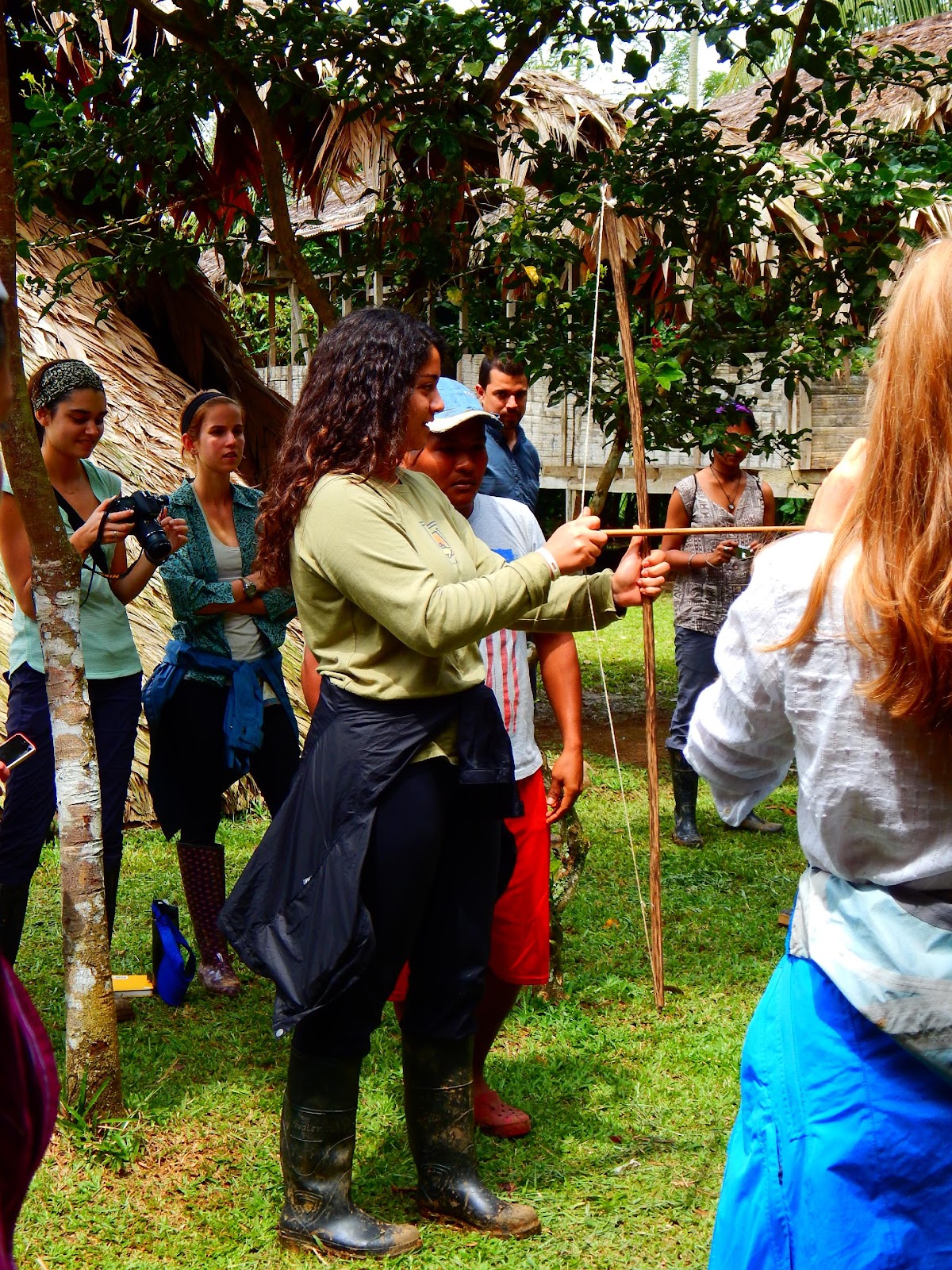
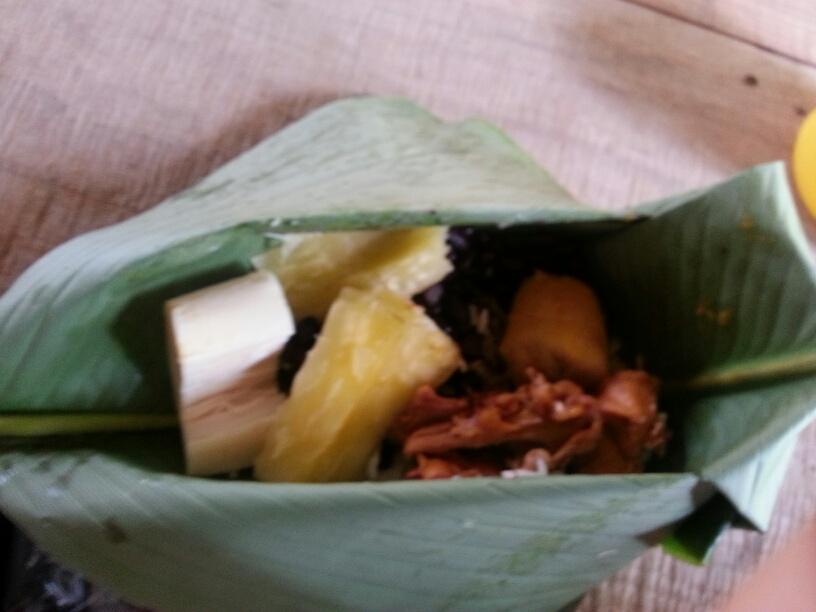
My constant amazement at how resourceful the indigenous people were was definitely a theme for me throughout the trip. The next day in the Bribri community, one of the leaders made a comment that truly stuck with me; he said the forest gives them everything they need, that it can be, “a supermarket, hardwood store, pharmacy, and source of water.” As I listened to the community healer, the Awa, speak in their native language, I also realized religion and their God, Sibu, are also linked to nature and the environment. To further our first-hand experience we then immersed ourselves in some aspects of their lifestyle: throwing arrows, visiting a sacred spiritual location in the forest, mashing corn with a stone, and completed the day by eating lunch on a leaf folded into a bowl! I found the communities interconnectedness and reliance on nature and the wild truly remarkable, and such a refreshing contrast to my way of life at home. 

On the bus back to La Selva, I felt privileged to have had such a unique opportunity, and was already looking forward to my next experience in Costa Rica that pushes me outside of my comfort zone.

Symone Stephens

Eating Leaves and Finger Painting: An Ethnobiology Lesson


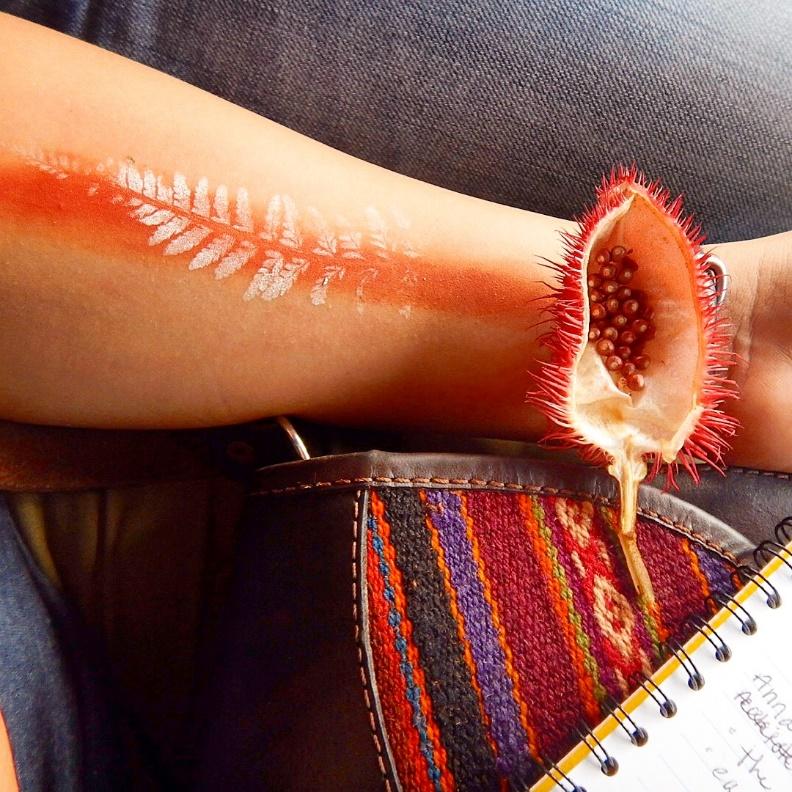
While we were at La Selva I saw so many animals and insects and plants on dozens of hikes and ventures out into the forest. We learned more species of medicinal plants than I can remember, but I think my favorite part of this time at La Selva was when Jaime lectured to us about these many many natural medicines. Jaime is really funny and an excellent speaker. He jokes about everything and understands what his audience wants to hear. We listened attentively while he showed us leaves that he and his niece and nephew gathered from the land around them. He told us how one leaf when steeped into tea can help you sleep. Another was good for digestion, though to be fair half of the leaves seemed to be good for digestion. He showed us this lipstick plant, a spiky red seed pod that has highly pigmented red seeds inside. We painted our arms with the seeds and then Jaime taught us how to use a fern to make a temporary tattoo on the red. We all were beyond thrilled with that.

Jaime also showed us raw ginger and had us taste it. It was incredibly spicy and most of us could barely let it sit on our tongue for more than a few seconds. Nearly every leaf he gave us he made us try. He would say before we bit into each one “Arriba! Abajo! A centro! Adentro” while we all repeated his chant. Some of the leaves tasted like, well, leaves. Others tasted oddly sweet. And still others were incredibly bitter. Jaime laughed at us when we nearly spit the bitter leaves out.

We ended our lecture when Jaime sliced up coconuts for us and had us drink them. The entire afternoon was spent learning traditional medicinal methods. It was fascinating to learn how these natural resources lent themselves to being more effective treatments than even modern pills can be. I think this experience was an excellent example of how this program expands your mind. I had always known that many medicines were originally derived from plants but never before had I realized that these were not only methods used by shamen, but also by everyday people who understood their inherent value. It was an excellent lesson by an excellent teacher, one of my favorite times at La Selva.

Marcela Zegarra-Ballon

Dengue for Science


During these past three weeks in Costa Rica, the most interesting instructions I have received so far are “don’t wear bug spray.” In the rainforest, they expect me not to wear bug spray? I’m a good sport, so on an overcast day at 8:30 in the morning, seven of us trooped out to the local town and a pineapple plantation sans bug spray. Our goal? To capture Aedes mosquitoes, which are known for carrying a disease called dengue that is a pretty big problem in Costa Rica. The no bug spray idea is sounding worse and worse.

A little background. We were conducting a Faculty Led Project (FLP) with an invited faculty member named Amanda. We were looking at the presence of Aedes mosquitoes in different areas around La Selva, including a nearby town, a pineapple plantation, and the rainforest itself. In order to catch these mosquitoes, Amanda had gone out a few days earlier and set up traps in order to catch both larval and adult forms of this mosquito. There were a few methods for catching them, but my personal favorite was the flashlight aspirator. They had basically repurposed a few flashlights and made them in to fans that were able to suck up adult mosquitoes in to a container so that we could take them back to the lab. They were really fun to use, even if I wasn’t very good at it. We had to look for the adult mosquitoes and quickly use the aspirators to catch them. This is where the “no bug spray” command came in to play.

In order to actually catch any mosquitoes, a few of had to roll up our sleeves and hold our arms out so that the mosquitoes would land on us so that they were easier to see and catch. This worked very well, and I am convinced that mosquitoes like Gringa blood a lot more than Tico blood. Although we were able to catch a decent amount of mosquitoes this way, most of the time the people with the aspirators didn’t move quickly enough. I got more than my fair share of mosquito bites. But all in the name of science!

Even though I didn’t appreciate the bites, it was still so much fun to sacrifice my body and blood for a good cause. We didn’t find any significant results, but we were able to catch a few Aedes adults using the aspirators and look at them under a microscope. Definitely worth the momentary pain.

And don’t worry, it’s been a while since then and I am not showing symptoms of dengue. But I’ll definitely wear bug spray next time.

Emily Leytham

Do We Learn Through Results or Processes?


My education has always been in a lecture format; therefore, I was excited to discover that the education here is experiential based. Each experience leads to a lesson learned and knowledge gained. The knowledge I am gaining is through processing the experiences, which involves observing, questioning, and discussing.

During our various walks in the forest with guides including Alex, Orlando, and Kenneth, they grabbed plants and easily identified the type, its uses, and history of it; they would also scan their surroundings and find tiny amphibians such as the blue jean frog. Unfortunately, rather than truly observing and absorbing the knowledge, I focused on writing down descriptions and imagining how to memorize all of these facts (typical of what I do in school). Then I realized this is not the way I will be able to learn here. So, with the more walks I take, the less notes I write, and the more observant I become.

I can go for a walk in the silence now, observe nature as a living and breathing object around me, and truly see the differences of the plants and animals. While I may not know names or uses yet, I see them as living, therefore making it much easier to remember their unique characteristics.

From this, I have learned the value of questioning. Rather than simply noticing that two plants share similar characteristics, I choose to ask if my observations are correct and how I can further identify them. My aim is not to guess the correct name, but to understand the “how” or the process of determining the plant. Not only am I learning how to ask questions that lead to more questions, but also how to question respectfully. I realized I feared that I would seem ignorant if I asked about someone’s culture, but I was wrong. Bribri clan members, for example, appreciate the curiosity and want people to learn about their culture because it shows that others value communities different from their own.

Finally, discussing ideas or concepts that I may not necessarily agree with also challenges me and further expands my knowledge. In the indigenous community there are clearly defined roles for women, such as preparing the cacao drink. While I understand this does not undermine women, it does however confine them due to their gender. Being open to hearing how the roles are understood in the culture has allowed me to gain a deeper appreciation for why the system is set up in this way. In my journey thus far, I have found myself truly enjoying experiential learning and becoming more focused on gaining my education through the process than by the result.

Morgan Drew

A Taste of Ethnobiology


“Ariba, a bajo, al centro….. al dentro!” Jaime sung out as we dropped a small, green, seemingly unimportant leaf into each of our mouths. Flavors of fresh citrus exploded inside my mouth. It is called bitter orange, or naranja adria, and is used by local Costa Ricans to make “tranquillo” relaxant teas. This plant is one of many used by local and indigenous communities for medicinal purposes. However, 10 minutes earlier, if I had seen this leaf on a tree, I would not have thought there was anything special about it other than its nice smell. This was the beginning of our first Ethnobiology lecture and was followed involved a vast demonstration of many plants people use for medicinal and practical purposes. Just a few of the names of plants we learned about were chiyote (makes natural red dye), lemongrass (used for teas), ginger (aids in stomach secretions), basil (cures earaches when combined with garlic), gavilana (cures stomach illness and elephantiasis), and quasia almata (cures stomach parasites). One of the most fascinating was called "piper" and acts as a natural anesthetic. Jaime instructed us to chew a leaf before we knew this however, and instantly our tongue and lips became numb and tingly! It was such an experience being able to touch, and smell and taste all these plants that could cure almost any simple illness you could think of. It made me wonder how many other natural products there must be all over the world that people use as remedies in their every day lives. To me they were just plants, but to Jaime, they were a way of life.

I left the lecture that day with a sense of awe about this whole new world of biology I never learned about in my cellular and biochemistry classes. Every plant has a story and purpose, no matter how small. To think I’ve walked past thousands in my life without ever giving them so much as a second glance. Ethnobiology encompasses so much more than just scientific knowledge. It encompasses an entire culture’s interaction with the environment around them. I believe that this first lecture was only a small “taste” of all we will learn about Costa Rica’s rich history of ethnobiology.

Stephanie Hynes

The Mono-Cropping Monster


Growing up in a rural farming community in Vermont, I've seen first-hand the benefits of small farms. I've known intuitively that local farms produce better produce for consumers and better outcomes for the farmers and their workers. In my house, “factory farms” is a curse word used to describe the evil corporations who are financially ruining our friends, harming our health, and suing our state. I've always felt this way, but I'd never actually seen these monstrosities until our visits to the plantations.

Finca Sura, the organic pineapple plantation, was idyllic, as evidenced by the reactions of my classmates. It was astonishingly beautiful, the samples were divine, and we all seemed to walk around in a daze of happiness. It's obvious when one tastes such produce that there is a difference in product quality based on how far food travels.

A few days later, when we went to the large-scale banana plantation, I heard utterances of shock all around me. We drove past miles and miles of banana trees with no plant diversity in sight. Each bunch of bananas was surrounded by a bag of chemicals and more chemicals were being sprayed from an airplane. We ended up moving our talk into the bus because the chemical plane was coming closer and we were concerned about inhaling...yet we eat these crops every day. Later, during our faculty led project, we stopped at a large pineapple plantation and watched a tractor spraying the fields. We debated whether it was spraying water or chemicals, because it seemed like way too much substance for it to be chemicals, until the scent hit us and it became clear that it was definitely not water.

I know it's unrealistic in our world today to eliminate food produced on a large-scale from our diets, but I have to admit that I was very struck by these experiences. It's one thing to have talked about it my whole life in an abstract sense; it's totally different, and much more powerful, to see it in action. As scary as it was to acknowledge these realities about our foods, I'm glad we did. It's too easy these days to ignore where our food comes from, yet I think it's an important factor to consider. We are putting these things into our bodies; it doesn't get much more personal than that. We have a right to know what we are consuming, but we also have a responsibility to care. For the sake of our health, our futures, and our planet, we have a responsibility to look at what we are growing and eating and think about the implications.

Krcmar Rachel

Tuesday, December 2, 2014

Mixin up the Medicine

    Did you ever want to be a sorcerer when you were a little kid? What about a healer, or an alchemist, or a mad scientist? I definitely did. During our trip to Las Alturas Professor Casey made me one.
    At 8:00 am we walked into the kitchen and were bathed by the aroma of ginger and a sickly smell of brown sugar. Professor Casey stood behind the picnic table laden with pots, burners, brown sugar, vodka, and heaps of smelly herbs. The sunlight from the window behind Professor Casey veiled her face in a shadow. She spoke. "Have you guys ever made herbal remedies?"
No.
But I want to!
    So it began. We went through a quick slideshow to learn the history of herbal remedies, and then 5 recipes were placed in front of us. A tincture, a scrub, a syrup, a lotion, and an ointment. We boiled, and we brewed, and we cackled at our creations.
    We tried everyone of then. I used the orange scrub on my face, which was made with 5 cups of brown sugar. Surprisingly, I couldn't put my face close to anything for the rest of the day for fear of being permanently stuck to it. The orange lotion made my skin feel like it had been lathered in holy water by Pope Francis himself, so naturally I rubbed it on every exposed part of my body. The ginger syrup took the longest to make, almost 2 hours, but oh was it worth it. Sweet and tart syrup that heals stomach pain and goes well with any food. The tincture takes 5-6 weeks to make. We're still twiddling our thumbs for that.
    The most amazing was the tea tree ointment. We used a slew of tea tree extract, almond oil, and bee's wax. A little know fact is that if you put these together in the right amounts, you get magic. The almond extract and bee's wax disinfects wounds, while the tea tree extract speeds the healing process. We literally made a healing ointment out of these three simple ingredients.
    ​It was amazing how we could make medicinal, cosmetic, and tasty concoctions out of herbs and natural substances. Not only did our activity give me respect for Mother Nature, but also it inspired me to keep making these brews at home. Thanks Professor Casey for bringing me one-step closer to becoming a medicine man!


-Will Johnson